University of North Texas

Curriculum Committees
Curriculum Committees
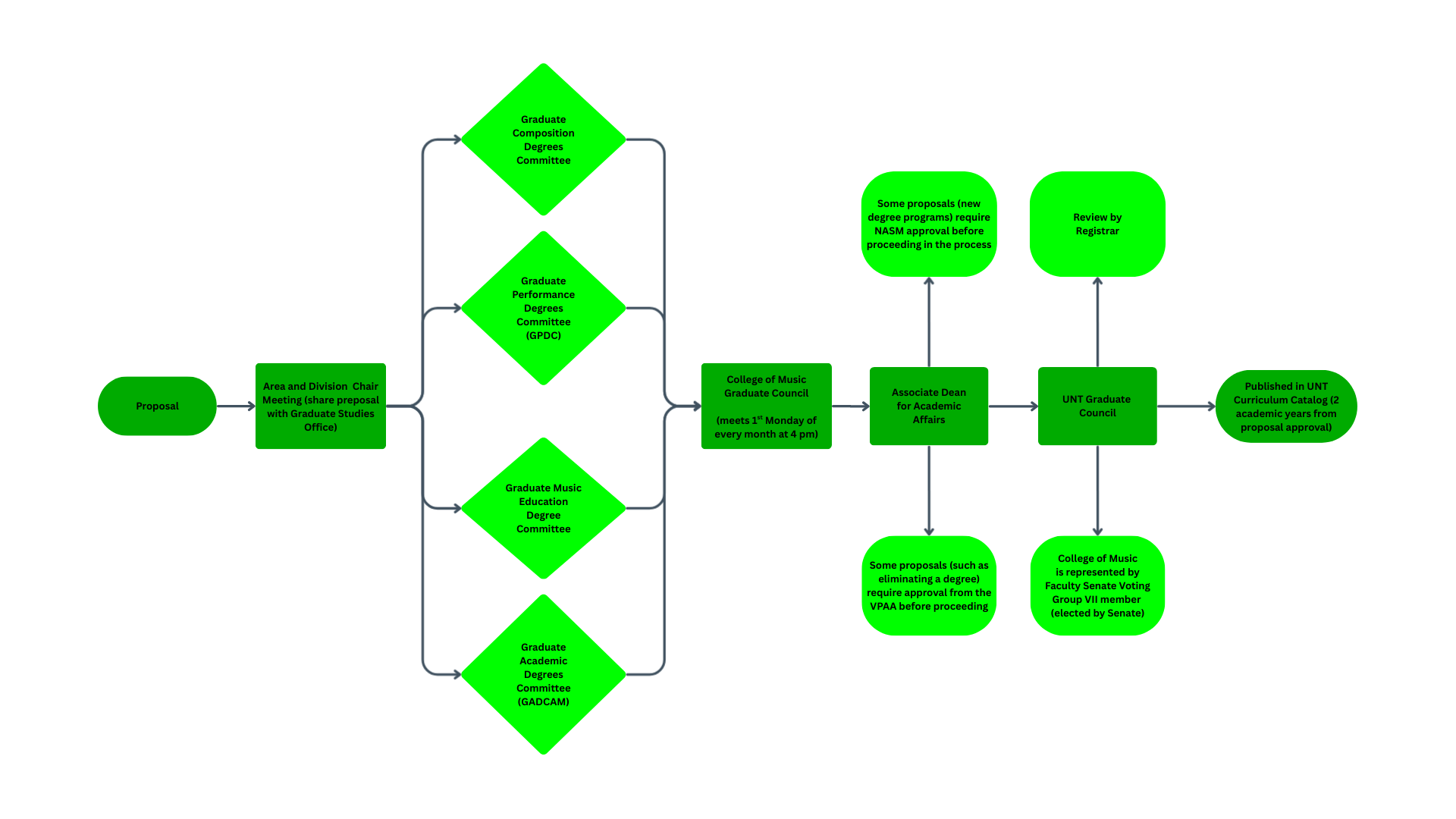
Curricular changes are “owned” by the faculty at UNT, meaning that any faculty member can make a proposal to the appropriate committees. Our proposal cycle is 2 years in advance, to allow for vetting, approvals, editing, and encoding before students register a semester in advance. A proposal approved during the 2022-23 school year will be published in the 2024-25 catalog. Proposals are discussed (when appropriate) by area, division, college and university committees before becoming official. Proposals can be tracked online at https://unt.curriculog.com
- The Graduate Performance Degree Committee (GPDC) comprises eight faculty members from the various performance areas as well as one each from music history and music theory. It reviews proposed changes to the MM and DMA degrees as well as student petitions for curricular exceptions. Finally, the GPDC reviews all DMA topic proposals and pre-proposals.
- Analogous curriculum committees exist for the following areas: composition; music history, theory and ethnomusicology; and music education.
- The College of Music Graduate Council is the preeminent curriculum committee in the college and comprises faculty members from all degree areas (performance, composition, music education, jazz studies, and music history/theory/ethnomusicology) as well as two elected at-large members, and the College of Music representative on the UNT Graduate Council as elected by the UNT Faculty Senate. The Director of Graduate Studies serves as chair, and it reviews proposed curricular changes to all graduate degrees in music as well as nominations for membership in the graduate faculty. The Graduate Council considers proposals for curricular changes after the proposal has been discussed and approved by the appropriate divisions.
- The University Graduate Council comprises faculty members from across the university, including one representative appointed by the Faculty Senate for Group VIII (Music, Media Arts, Dance & Theatre Arts). It reviews proposed changes to all graduate degrees throughout the university.
College of Music Graduate Council
The College of Music Graduate Council is responsible for all graduate programs in the College of Music and serves as the graduate curriculum committee. The council will study the deletion, modification, or addition of any graduate course, the termination, modification, or creation of graduate programs and make recommendations to the Senior Associate Dean for Academic Affairs. The council administers various tasks in consultation with the Toulouse Graduate School.
The Council is chaired by the Director of Graduate Studies and is comprised of Chairs of the various graduate committees and the College of Music representative to the University Graduate Council. The Dean and the Associate Deans serve as ex officio members. Additionally, two at-large members of the Category III Graduate Faculty will be elected by the plenary faculty and will serve three-year terms. The Graduate Council typically meets from 4:00-5:30pm on the first Monday of every month during long semesters.
Graduate Council Members (2025-2026)
- Dr. Jaymee Haefner, Director of Graduate Studies
- Dr. Jung Choi
- Prof. Steven Menard
- Dr. Phillip Paglialonga
- Dr. Andrew May
- Dr. Donald Taylor
- Dr. David Bard-Schwarz
Ex Officio Members
Dr. John Richmond, Dean, College of Music
Dr. Warren Henry, Senior Associate Dean for Academic Affairs, College of Music
Dr. Kirsten Soriano, Associate Dean for Operations, College of Music
College of Music Curriculum Flow Chart
Below is a flowchart showing the proper channels for proposing changes to curriculum. All proposals must first be approved at the Area-level, then Division-level, then by the appropriate curriculum committee before being sent to the CoM Graduate Council for approval. From there, proposals are approved by the Associate Dean for Academic Affairs, then the UNT Grad Council before being published in the UNT Catalog. Curriculum changes take 2 academic years to go into effect once approved and will not be published in the Catalog until then.