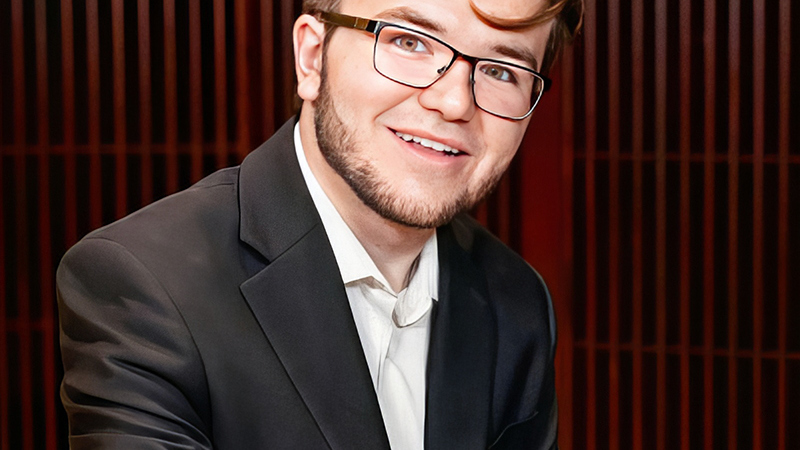
Q & A with Dean James Scott

College of Music Dean James Scott took some time recently to discuss his Jan. 28 recital with doctoral guitar student Armin Abdihodžić:

Q: As dean, your work requires travel, long hours, and late nights attending concerts. How do you find time in your schedule to prepare a recital?

A: I have to plan for performances in those parts of the year that are either just after a break or after those parts of the season that have few evening concerts. I can do “midnight maintenance practice” once I have time to get back in shape after a lapse, but preparing a full program that includes new repertoire calls for better quality time. When we are in the busiest part of the academic year, I really can’t plan to perform.

Q: Why is it important to you to continue to perform?

A: There are several reasons. First is my own inner need to continue practicing the art, and without the goal of performance, other responsibilities always overshadow the desire to make music myself. Second is the pleasure of sharing in the making of music with faculty and/or student colleagues. It's important for a dean not to remain too far removed from the work of students and faculty in order to stay connected with both the joys and challenges. Finally, in a music school, both academic and artistic leadership is central to the role of the dean, and credibility for artistic leadership can be heightened if it is clear that the knowledge, values, and skills of the dean are aligned with those of students and faculty.

Q: What made you decide to perform with a student guitarist for this recital?

A: I first heard Armin in a chamber music setting at a "friend-raising" house concert, and was very impressed with his playing and his overall professionalism. He expressed interest in the flute literature that includes guitar, so I invited him to perform in a quartet with us last season. His outstanding work in that concert led to the plan of doing an entire program of just flute and guitar music – a particularly beautiful genre. Throughout my career, I have always been an advocate of faculty and students working together in playing chamber music. There are many precedents for this in other schools as well as in our own. On Jan. 22, incidentally, I played a flute and piano work with another doctoral student. I should mention that I consider our top doctoral students as younger professional colleagues, in every way equivalent to those I would encounter in the outside professional world or as junior faculty members. I remember from several decades ago an older colleague pointing out that we learn from those younger than ourselves as well as the reverse. Now that I'm on the older end of things, I absolutely feel that way, too.

Q: Are flute and guitar commonly paired together in music?

A: Yes, there is a lot of beautiful repertoire for the combination of the modern flute and guitar from the early 19th century up to the present. The intimacy of the guitar sound creates a unique contrast to the sustaining voice-like quality of a flute. Essentially, it is the combination of such a breath-based instrument paired with plucked stringed instruments that makes for a number of beautiful combinations. There are indeed similar, but still distinctly different effects for flute with harpsichord and harp, not to mention the use of lute in earlier times.

Q: You will be playing a piece by visiting composition professor William Coble. What is it like to perform a work by one of your own faculty members?

A: I am very happy to be doing this again. For more than 40 years, I've played the music of colleagues, and there is nothing like being able to collaborate with a composer on the realization of his or her music. A living, present-day composer can answer the kinds of questions one would wish to ask the composers of music of the past. As detailed as a score might be, it is only a blueprint for the actual life of the work, and there are many choices still to be made. Sometimes discussions even lead to small changes in the score itself.

Q: The program also includes works by Giuliani, Hoover, Flagello and Damase. What led you to choose these particular pieces?

A: The Giuliani sonata is a delightful work characteristic of the tastes of Congress of Vienna culture in the early 19th century. It is full of beautiful melody and wit. The Katherine Hoover piece is highly evocative through its musical retelling of an Apache folk tale. The Flagello, in my opinion, is a masterwork for the combination of flute and guitar and is undeservedly unknown. Its complexities and emotional tone suggest a work of genuine importance. For the remaining work, I gave Armin several scores to choose among, and the Damase was his choice; it is a new venture for both of us. It is totally French in its lightness and charm. Think of the most sumptuous French pastry!

Q: What is your favorite musical moment on the program, and why?

A: As with almost any program, my favorite moment is the one I'm playing at any given time!

Event Details:

What: Faculty Recital – James Scott, flute; Armin Abdihodžić, guitar

When: 8 p.m. Monday, January 28

Where: Voertman Hall, UNT Music Building

Cost: Free